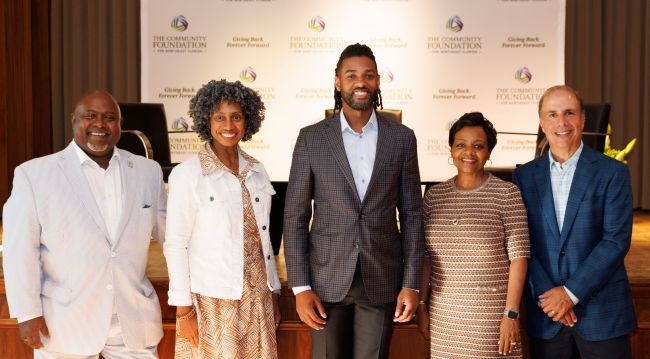
On August 26, 2025, The Community Foundation for Northeast Florida hosted a Donors Forum at the Cummer Museum to discuss What’s Next for Philanthropy in a Changing Landscape? This forum was held during Black Philanthropy Month, and an introduction by the Foundation’s Vice President for Civic Leadership Wanda Willis recognized the powerful work that a number of funds at the Foundation have been doing, including the A.L. Lewis Black Opportunity & Impact Fund, the Earth M.M White Legacy Fund, and the MyVillage Project. Foundation President Isaiah Oliver then introduced the two guest speakers who joined him in a fireside chat and Q&A.
Joe Scantlebury is President & CEO of Living Cities, a member collaborative of leading philanthropic foundations and financial institutions committed to closing income and wealth gaps in the U.S. Joe was formerly President for Place-based Programs for the W.K. Kellogg Foundation, Senior Program Officer, U.S. Program Advocacy at the Bill & Melinda Gates Foundation, and an attorney at the Youth Law Center. With parents born in Panama, Joe’s formative years were spent alternately between Panama and Brooklyn. Even while experiencing what were thought of as “tough” environments, Joe learned at a young age the simple truth that no matter where they come from, very few people grow up thinking they are not worthy.
Dr. Sherece West-Scantlebury has been President & CEO of the Winthrop Rockefeller Foundation for 18 years, leading efforts focused on transforming systems across education, economy, and social class in Arkansas. She formerly served as the CEO at the Foundation for Louisiana and as a program associate at the Annie E. Casey Foundation. Sherece grew up in Baltimore public housing, and she always felt that something was not quite right, as she saw glass on playgrounds and shootings in the neighborhood. She has spent her life pursuing the question of why, which has concentrated her in the non-profit world and led philanthropy to find her.
Key Points from the Guest Speakers
- Joe and Sherece were asked what they have learned from each other:
- Sherece has learned patience from watching Joe model in how he interacts, talks, and listens to people. He has also inspired her to not question that she is “not enough,” to trust her reliance on empathy and intuition, and to lean into exactly who she is and be herself at all times.
- Joe admires the clarity of Sherece’s commitment to leadership, especially in a world where women’s contributions and power are often not acknowledged and their voices not heard. He has learned to be her advocate if her leadership is ever discounted.
- Despite the fact that there is a trend to deny or ignore systemic issues, data does not lie — and our eyes and experience do not lie. Just because the conversation is uncomfortable does not mean the problems are not there.
- People who experience inequity are all around us. And if that is not acknowledged, the question can become: “Why don’t you want us to talk about it?”
- It does not matter what city or location you are in, if there is an abandonment of services, disadvantages, or disinvestment, the negative outcomes are the same. And the systems and institutions that created these decisions are often race-based. Geography matters, of course, and there are differences in rural and urban environments. But experience and lessons learned are definitely transferable from place to place.
- Living Cities partners with local communities on the municipal, community, and civic levels, and they constantly ask the question “How do we share info about what we achieve with other cities?”
- In the philanthropic space, if we see the efforts as rescuing people, we are failing. We need to see the people we are helping as partners and engineers in the solution.
- In this moment of great hostility toward non-profits and matters of race and equity, we have opportunities to invest differently in organizations. Rather than focusing on short-term, project-based grants (which do not necessarily contribute to the sustainability of an organization), unrestricted multi-year funding can enable organizations to strengthen their resilience and stability for the long term.
- Chronic, long-term problems need different solutions. There is a difference between charity and transformational grant-making. If you are seeking systemic change, grantmaking is long term and takes significant dollars.
- Restrictions on grants and strict impact measures erodes trust between grantmakers and grantees, and it should be the job of program directors to translate the outcomes, not reliance on the grantees to defend and explain outcomes.
- Impact should be a negotiation with the grantee partner. We often expect only positive results. And many times, something is being tried that has not been done before. There is a trial and error/fine-tuning aspect to it, where more work needs to be done in the future until we get it right.
- Grantee partners often do not realize the power they have to effect this change in philanthropy by asking for these unrestricted grants. They would benefit from organizing, approaching the community, and explaining how current funding is not working.
- In order to build an effective and comprehensive table, those of us who commit to serve must talk to each other to find shared solutions and be respectful of each other. If someone leaves the table because they feel uncomfortable in the current environment, it is important to maintain the relationship and ask for their continued support. Everyone still wants the same thing. Philanthropy has the opportunity to create this democratic and shared space.
- Three final recommendations:
- Fund strength, not scraps. Multi-year, unrestricted gifts will help effect greater change and promote resiliency.
- Think effectively, not competitively.
- It is important to actually invest in — and trust — those leaders who are closest to the work.
Continue the conversation on the Forever Forward Podcast! Isaiah Oliver sits down with Joe and Sherece in the studio. Listen Now.
Explore More Donors Forum Topics

New Insights on a Critical Partner in Affordable Housing
The Community Foundation for Northeast Florida hosted a Donors Forum at the River Club to discuss New Insights on a Critical Partner in Affordable Housing with guests Stan Fitterman and Anne Ray.
What’s Next for Philanthropy in a Changing Landscape
On August 26, 2025, The Community Foundation for Northeast Florida hosted a Donors Forum at the Cummer Museum to discuss What’s Next for Philanthropy in a Changing Landscape? Foundation President Isaiah Oliver was joined by Joe Scantlebury and Dr. Sherece West-Scantlebury for a fireside chat and Q&A.
The Impact of Collective Giving
On April 17, 2025, The Community Foundation for Northeast Florida hosted a Donors Forum at the River Club to discuss The Impact of Collective Giving. The featured speaker was Michael Layton, Philanthropy Chair at the Dorothy A. Johnson Center for Philanthropy.