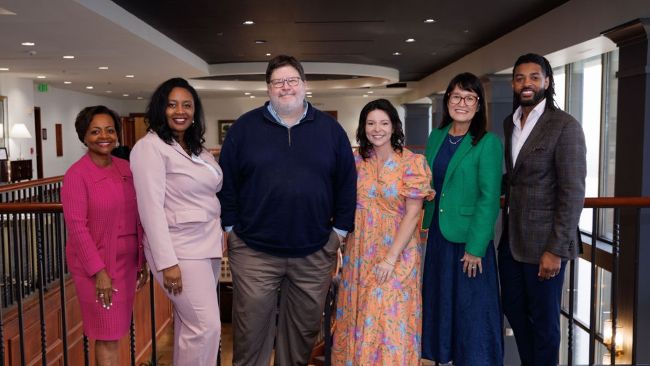
On March 26, 2026, The Community Foundation for Northeast Florida hosted a Donors Forum at the River Club to discuss Investing for the Future: How Early Learning Shapes Young Minds. The keynote speaker was Dan Wuori, the founder and president of Early Childhood Policy Solutions and author of The Daycare Myth. A former kindergarten teacher and school district administrator, Dan is an internationally recognized expert in early childhood development and policy. From 2005–2018, he was Deputy Director of South Carolina First Steps to School Readiness, a public-private early learning initiative, where he helped develop bipartisan support for early childhood education and oversaw system innovations. He also serves as a strategic advisor on early childhood for the Saul Zaentz Charitable Foundation.
Keynote Speech Highlights from Dan Wuori:
- Several decades of developmental research and brain science can be distilled into three simple truths:
- Learning begins in utero and never stops.
- The period from prenatal to age three is a uniquely consequential window during which the fundamental architecture of the brain is wired.
- Optimizing that brain development is highly dependent on stable, nurturing relationships with highly engaged adults.
- Our current systems are poorly aligned with these three truths. Our country’s approach to young children has historically failed to acknowledge how important the period from prenatal to three really is, and we have positioned early day care as less important and educational than later traditional places of learning.
- In policymaking, the rationale for investing in early childhood education is for children to come to kindergarten “ready to learn.” Yet this framing does not reflect the reality that learning has been happening since infancy.
- Childcare programs consist of an almost entirely female workforce in most states, with a majority of women of color, with a median wage for an infant teacher of $13.22 an hour (59 cents less than the average pay for dog walkers).
- Childcare workers are working with children during the most formative time of development. Yet we do not compensate them as teachers. And the four-to-one ratio of children to adult which is the nationally accredited gold standard implies that one worker can meet the needs of four babies at a time — which any parent can attest seems unattainably labor-intensive.
- The Heckman Curve, attributed to Nobel-Prize winning economist James Heckman, calculates a 13.1% rate of return for public investment in our very young children — beginning prenatally.
- Although the U.S. actually spends most of its money on K-12 and higher education, investment in children at earlier ages has been shown to decrease costly negative outcomes like remediation, grade level retention, interaction with criminal justice system, etc.
Following the keynote remarks, a panel discussion was moderated by Rachael Tutwiler Fortune, president of the Jacksonville Public Education Fund, which leads efforts to close opportunity gaps and ensure every child has access to high quality education. The discussion included Dan Wuori, Stacy Baier, Ph.D., Senior Vice President, Florida Community Engagement, Operations and Strategic Partnerships at the Helios Education Foundation, and Makayla Buchanan Chief of Staff at The Children’s Movement of Florida.
The Helios Education Foundation was created in 2004 to support postsecondary attainment for all students in Arizona and Florida, with an emphasis on low-income and underrepresented communities. In her role, Stacy leads staff engagement with the community and stakeholders to improve quality, access, and achievement across the birth–16 education continuum.
The Children’s Movement of Florida advocates for the policies and investments that help each child in Florida thrive in their first five years. Formed in 2010, the organization recently released a two-year collaborative effort, Florida’s Early Learning Roadmap, which reflects insight from nearly 1,000 Floridians, 65 listening sessions, and 100 statewide conversations. As chief of staff, Makayla is a key leader in executing the organization’s strategic initiatives and priorities.
Main Takeaways from the Panel Discussion:
- By age three, a child’s brain is roughly 80% of the size of its adult brain, and is 90% by age five. Early literacy gaps can be demonstrated before age two.
- Across Florida, only 44% of our children enter school ready to learn (37% in Duval County). It’s extremely expensive to catch them up later. If a child went to a VPK program, the percentage rises to 70%.
- The idea that literacy happens in first, second, or third grade is really a misnomer. The foundations of literacy begin much earlier, even prenatally.
- The workforce in childcare is paid so poorly that roughly 40% of the workforce leaves each year for a higher paying job. Investing in the needs of the adults in the field is critical to addressing the quality of childcare.
- Affordability is a huge challenge for families in accessing high quality early learning opportunities — around 13.5% of a median household income goes to the cost of one infant in care. Childcare is the number one reason a parent in Florida with children under six will quit their job or reduce work hours. Fifty-five percent of work absences are due to childcare issues.
- Setting students up for a successful educational trajectory begins at birth, so investing along the entire education continuum is vital.
Philanthropy Can Be Most Helpful By:
- Ensuring we are investing in evidence-based practices that are moving the needle.
- Making sure we are focusing on the right things and making investments that can be sustained beyond the initial investment.
- Taking the opportunity to shake up the status quo and point out to policy makers those things that may need to be happening that aren’t always happening.
- Use voices to help policy makers understand why investing in the early childhood workforce is a smart investment.
- Bringing together public and private dollars like in higher ed to come up with innovative solutions and create something for the birth-to-five space.
- Acting as a bridge to leverage philanthropy to fill in gaps to redirect resources where they are needed.
The next Donors Forum will be April 30, and the topic will be Food Insecurity in Focus: Policy, Practice, and Philanthropy.